KRA and Digital Transformation
Digital transformation
In a rapid technological advancement era, countries are moving towards a future defined by digital connectivity and innovation. Countries are embracing digital transformation to reshape their economies and this is more evident and vital in the African continent. Qhala stands at the forefront of catalysing Africa’s digital transformation working together with organisations to make this a reality. Yet, there is still a lot that needs to be done, right from understanding what digital transformation is and the role it plays in ensuring an organization’s efficiency and sustainability.
This blog shares insights gathered from a public lecture by Dr Shikoh Gitau at the 9th Annual KRA Tax Summit where the theme was building a resilient and progressive tax system. The session, “Creating an Economy on Supersonics: The Role of Digital Transformation” delved into Kenya’s digital transformation journey and its implications for organisations, specifically the Kenya Revenue Authority (KRA).

“Digital transformation is participatory, human-centred and customer-centric” highlighted Dr Shikoh Gitau, CEO and Founder of Qhala Limited, and speaker of the session.
Dr Shikoh took the delegates through Kenya’s digital journey which started two and a half decades ago. She highlighted the significant pieces of registration for Kenya on digital economy and transformation, and KRA’s journey. Currently, Kenya is one of the most financially positive countries in the world. More data presented during the lecture revealed that Kenyans are the top per-capita users of social media. This can be attributed to the percentage of mobile phone subscription penetration in Kenya which is more than 100%. Additionally, out of about 51 million people, there are approximately 17.86 million internet users.
“Kenyans are using social media to trade, communicate, to get work, to do work and all this is to grow the economy”
What is digital transformation?
Digital transformation in business goes beyond digitization and digitalization. It involves a radical rethinking of how an organisation utilises technology, people, and processes to enhance business performance and customer experiences. Dr. Shikoh emphasised the shift in customer demographics, highlighting the need for communication tailored to the preferences of later-aged millennials and older Gen Zs, who have the concentration span of social media reels.
“ It is about the customer and this is because the customer has changed. The average age of Africa as a continent is 19 years, this means that the people who are becoming decision makers and taxpayers are later aged millennials and very older Gen Zs. They have the concentration span of an instagram reel, this means you have to ensure your content is an Instagram reel or Tiktok videos so that it can easily be consumed where they are. Communication has to be effective”
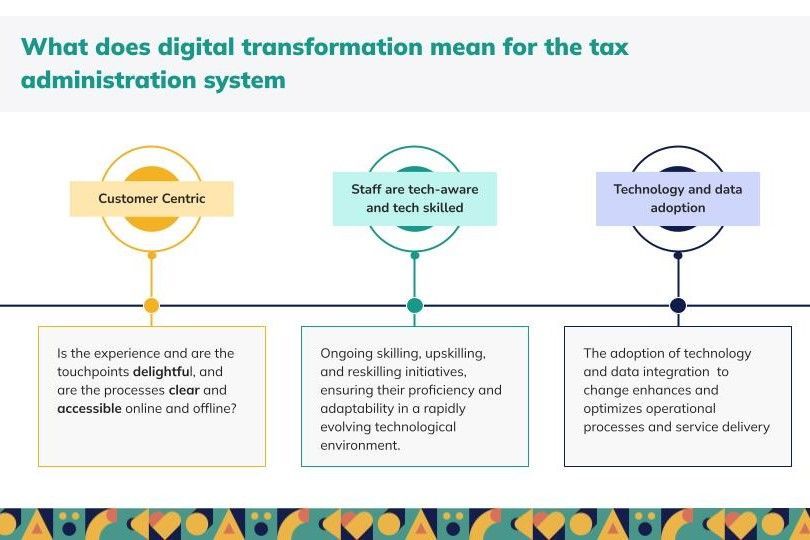
Characteristics of Digital transformation in a tax administration
Key elements include customer-centricity, tech-aware staff, and the adept use of technology and data. Dr. Shikoh stressed the holistic customer experience, emphasising that digital transformation extends beyond technology. It necessitates clear offline and online touchpoints and a workforce continually upskilled to improve efficiency. Despite KRA making strides in digitalizing tax systems in comparison to other countries like South Africa and Rwanda, there is still something more that can be done.
An exercise on Menti showed that on a scale of 1 to 10, KRA’s customer-centricity was at an average of 5.4 while the tech proficiency of KRA staff was at an average of 5.7 and KRA’s use of technology and data to fulfil its mandate scored a 6.4 average
Digital transformation principles for KRA
Dr. Shikoh proposed five principles — simplicity, inclusivity, transparency, data security, and delightful user experiences — as the cornerstone of KRA’s digital transformation journey. These principles, aligned with tailored services and collaborative partnerships, can foster engaged staff, innovative products, higher tax compliance, and increased customer satisfaction.
Throughout the lecture, the emphasis was on customer-centricity. Understanding the customer’s age, persona, online presence, and communication preferences is essential. Thinking creatively, integrating education and tax awareness, and prioritizing data protection are crucial steps. By focusing on customer needs, promoting tech awareness among staff, and leveraging technology and data, organizations can transform their digital landscape.
About Qhala:
At Qhala, we recognize the immense potential digitalization holds for Africa’s transformation. Our mission is to ignite Africa’s digital transformation journey by empowering our communities and tech leaders with cutting-edge digital solutions and laying strong foundations for a digital-first economy.
Feel free to reach us here if you need help in your digital transformation journey.
#Digitaleconomy #Qhala #Digitaltransformation #Africa #Digitalization #Data #Technology #DigitaltransformationAfrica