The CTO Roundtable: Shaping the future of tech leadership in Africa through Collaboration among Technologists
Future of tech
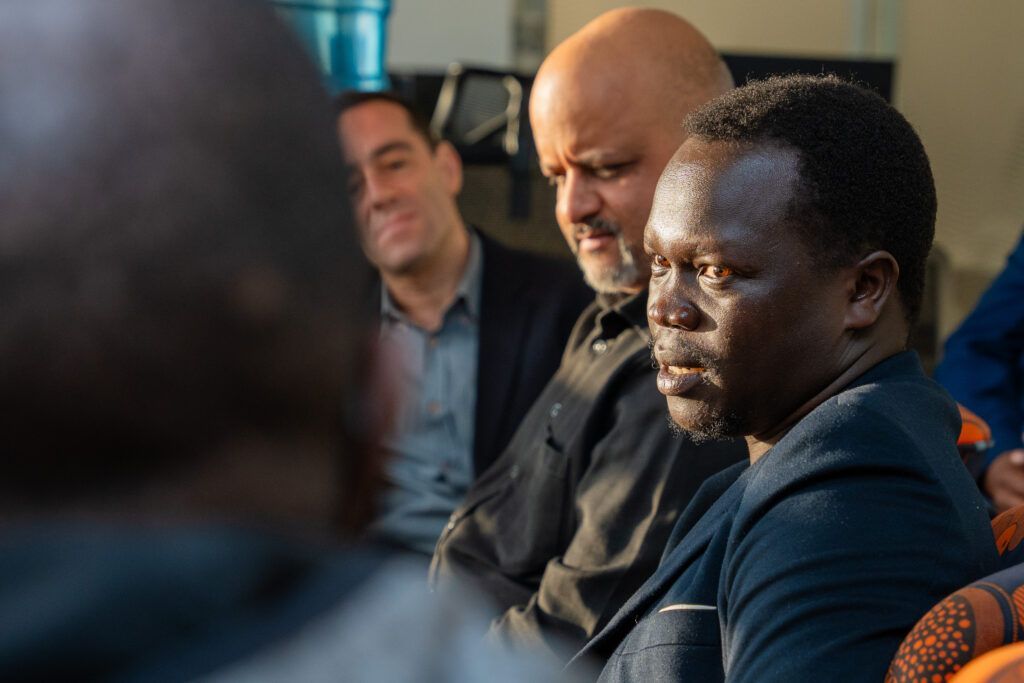
On February 18th, from 7 to 9 AM, more than 30 Chief Technology Officers gathered for the CTO and AI Breakfast Roundtable hosted by Qhala. Also in the room were other tech executives, including CIOs, CEOs, and tech directors. They exchanged ideas on creating new business models, leveraging data for sharper decision-making, building AI-ready foundations, and addressing talent gaps. The conclusion of the roundtable could not be clearer: Africa must build for Africa, for no one else is coming to do it for us, and collaboration is the route we must take to make this a reality.
Collaboration Over Isolation: Building Africa’s
Future Together
In his opening remarks, David Kiania set the tone for the roundtable, emphasizing that technology leaders in Kenya must move beyond working in silos and instead collaborate to build a thriving African tech ecosystem. “Let us be lofty, and let us also be baseline,” he urged, spurring the CTOs to set ambitious, visionary goals while at the same time remaining grounded in practical, actionable steps to drive real technological transformation. This marked the third CTO meeting, following the first Roundtable at Jacaranda during COVID and Qhala’s second edition held in 2023. He fondly recalled that several startups—now among the country’s leading tech giants—were born out of the first CTO Roundtable. Under the stewardship of Dr. Shikoh, Qhala aims to make these gatherings a quarterly tradition, ensuring sustained engagement and action.
Dr. Shikoh underscored Qhala’s mission as an ecosystem builder, bringing together African technologists to innovate for the continent’s future. “No one is coming to save us,” she remarked, striking a chord with the audience. The discussions that followed proved this point over and over again.
AI and Hardware Innovation: Can Africa Bootstrap Its Way to Scale?
Felix Omwansa from Geviton took the stage to discuss AI and hardware innovation in Kenya, particularly focusing on Battery Management Systems for energy mobility and hardware solutions. He highlighted the persistent challenge of capital constraints that hinder scale, with the industry still heavily reliant on bootstrapping.
In response, Ben Roberts conducted a quick survey among attendees. When asked how many design electronics, six hands went up. When asked how many use locally-made electronics, five responded affirmatively. However, when he inquired how many would be willing to use locally-made electronics after hearing Felix’s presentation, over 20 hands shot up. This moment encapsulated the essence of the roundtable—the solutions must come from within, and Africans must invest in their own innovations.
Bootstrapping alone is not the path to scale; true growth will come when African technologists and businesses invest in and prioritize locally-made innovations. As Ben Roberts’ survey demonstrated, the key to scaling AI and hardware in Africa lies within—through collaboration, trust, and a collective commitment to supporting homegrown solutions rather than looking outward for validation or capital.
Inspired by the engaging discussion, a proposal was made to dedicate a future CTO roundtable specifically to AI and hardware collaboration. Qhala will announce details in the coming months.
Beyond the Cloud: The Future of AI in Africa Lies in Distributed Computing
The second presentation, delivered by Dan Desjardins, CEO of Distributive, delved into the transformative power of distributed computing. In his talk, titled “Beyond the Cloud,” Dan challenged traditional computing paradigms, highlighting how GDP growth is intrinsically linked to computing capacity.
He outlined three ways to acquire compute power:
Buying and building data centers
Renting cloud services
Leveraging existing compute capacity by sharing computers
Dan argued that the first two methods drain Africa’s resources, as cloud providers from the Global North continue to reap financial benefits. Instead, he championed the third option—distributed computing—which is often overlooked due to security concerns. The security concern that plagues distributive computing is: How can we protect the computer from the code, and how can we protect the code from the computer? He tackled these concerns head-on, explaining how techniques like sandboxing, virtualization, and containerization protect computers from malicious code, while homomorphic encryption and Trusted Execution Environments (TEEs) safeguard the code from untrusted nodes.
Dan’s insights resonated deeply with the audience, prompting many to request a follow-up session dedicated solely to distributed computing. In response, Qhala announced an upcoming Compute Webinar on February 27, 2025, from 5 PM to 6:30 PM EAT.
What to Expect from the Compute Webinar:
Learn how to set up computing faster and cheaper than commercial cloud services
Run large-scale AI/ML, data science, and simulations efficiently
Experience a live demo featuring Python, C++, Rust, and more
Explore use cases from research labs, AI projects, and financial modeling
Opportunity to receive $1,500 in cloud credits to test workloads
Technologists (and every other curious mind out there!) are invited to the webinar and are encouraged to register here: https://lu.ma/f00tiyjo
Dan also shared an inspiring use case from African Nazarene University, where distributed computing was successfully piloted for developing a Natural Language Processing (NLP) model. This real-world application demonstrated how Africa can bypass expensive cloud solutions by harnessing its existing computing power.
Lessons from China: What Africa’s CTOs Can Learn from DeepSeek and Huawei
A delegation from Huawei at the roundtable shed light on an extraordinary collaboration between Huawei and DeepSeek, a Chinese AGI company that has become a household name almost overnight. Huawei provided DeepSeek with its advanced Ascend AI chips and cloud computing infrastructure, enabling the company to train and deploy massive AI models despite U.S. restrictions on NVIDIA GPUs. This partnership not only propelled DeepSeek to the global AI stage but also exemplified China’s commitment to technological self-reliance.
African CTOs have much to learn from this Deepseek miracle. But this is not the first time such rapid technological advancement has occurred. The East Asian Miracle of the mid to late 20th century saw countries like South Korea, Taiwan, Singapore, and Hong Kong undergo a massive technological shift, leading to unprecedented economic development. If there is anything Africa can learn from DeepSeek and the East Asian tigers, it is that collaboration among CTOs can spark technological breakthroughs that drive economic progress and lift entire nations out of poverty.
Who knew that CTOs wielded so much power? The time has come for African technology leaders to create their own “African Miracle.” The rallying call of Africa Rising must go beyond rhetoric—African CTOs must build Africa for Africa by Africans. If the East Asian Tigers did it, so can we.
A Call to Action: The Future is Ours to Build
Dr. Shikoh closed the event with a rallying cry: “We must work together because no one is going to do it for us. Nobody is building Africa but us.” Her words left the audience energized and ready to take actionable steps toward an AI-powered, self-sustaining African tech ecosystem.
As Qhala continues to foster these crucial conversations, the future of Kenya’s tech industry—and Africa’s broader digital economy—looks brighter than ever. Through collaboration, innovation, and a commitment to homegrown solutions, Africa is poised to lead the next technological revolution. And collaboration among technologists might just be the silver bullet that gets us there.
PS: For those who missed the live discussion, the full CTO Roundtable recording is available here: Listen to the CTO Roundtable
A special thank you to Carolyne Mweberi Snr. PMM Qhala and James Odede – Co-founder and CTO AquaRech LTD for planning the event.
Next steps: Qhala will be hosting CTO Roundtables every quarter in its bid to catalyze the African tech ecosystem. Stay tuned for the next CTO Roundtable and be part of the movement shaping Africa’s digital future.